Cryptograph

Free daily card games
A new deal every day, solved before it goes live, so it can always be won.

Cryptograph
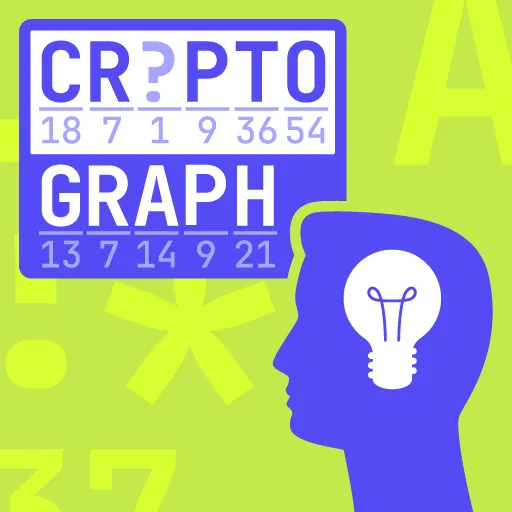
Cryptograph replaces every letter of a quotation with a number and asks you to put the letters back. One number, one letter, consistently for the whole puzzle.
Coding the alphabet as numbers instead of other letters changes the feel more than you would expect. There is no false familiarity to fight, no word shape that looks almost readable, so you are forced onto the two things that actually solve these puzzles: how often a symbol appears and where in a word it sits.
The letter for letter version is Cryptic Quotes if you prefer the traditional presentation.
How to play Cryptograph
- Choose a number in the coded text.
- Assign it the letter you believe it represents.
- Every occurrence of that number changes at once.
- Change an assignment at any time if it stops working.
- The puzzle is done when the quotation reads as English.
Consistency is the lever
Because the substitution never varies, a single correct guess pays out everywhere. Assigning E to the right number can fill a dozen positions in one stroke and turn an unreadable line into a set of recognisable word shapes.
Which is also why one wrong assignment held onto stubbornly can waste a great deal of time. If a word will not resolve, suspect the letter you are most confident about.
Tips and strategy
Count first, guess second
- Tally which numbers appear most. The top one is usually E, with T, A, O, I and N following.
- Look at what ends words. E, S, D and T dominate final positions.
- Look at what starts them. T, A, S, H and W are the common openers.
Short words carry the most information
- A one letter word is A or I.
- Two letter words come from a list of about twenty: of, to, in, is, it, as, at, on, or, be, by, he, we, an, so, no, do, up, my, me.
- Three letter words are dominated by the, and, for, but, not, you, all, can, has.
Solving one three letter word usually gives you three letters, and three letters is normally enough to start reading.
Structural clues
- An apostrophe with one letter after it is S or T. With two it is RE, LL or VE.
- Doubled numbers are most often LL, EE, SS, OO or TT.
- A comma is frequently followed by and or but.
- A number appearing exactly once is likely to be J, Q, X or Z, and can be left until the end.
When you stall
Stop applying rules and read what you have out loud. Half completed words solve themselves through recognition long before frequency analysis gets there, and the brain is better at filling gaps than at counting.
More games like this
Play our free daily puzzles
See all →Made by us. One a day, the same for everyone, no sign up.
Orientation
Built for a landscape screen. On a phone, turn the device sideways.
Last updated
Frequently asked questions
How does Cryptograph work?
Each letter of a quotation is replaced by a number, consistently throughout the puzzle. You work out which number stands for which letter and the quote appears.
Where should I start?
With the number that appears most often, which is usually E, and with the one and two letter words, because they have very few possible answers.
What if I make a wrong assignment?
Change it. Nothing is permanent, and if a word refuses to resolve the culprit is often the letter you were most sure about.
Do I need to recognise the quotation?
No. Every puzzle can be solved from frequency and word shape alone. Knowing the quote is a shortcut, not a requirement.
Is Cryptograph free?
Yes, free in the browser with nothing to install.