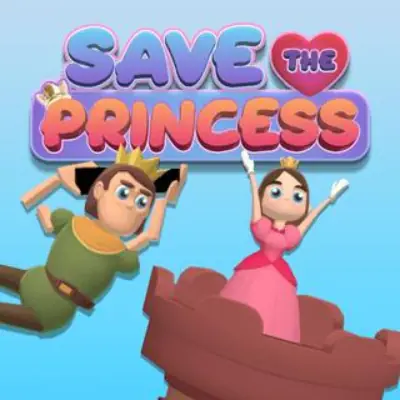
Save The Princess



Save The Princess
Save The Princess hands you a line and a ragdoll. You draw the line, the prince follows it, and physics decides the rest.
The drawing is the easy part. What makes the game is that everything else on the screen is moving, so the path that works is only correct for the two seconds when the gaps happen to align. Draw the right route at the wrong moment and the prince is knocked off it.
More than forty levels, all built around the same tension between where the path should go and when it should be drawn.
How to play Save The Princess
Each level puts the prince at the bottom and the princess somewhere above.
- Hold down and draw a path with the mouse or your finger.
- The prince moves along the line you have drawn.
- Release the line and it stops guiding him.
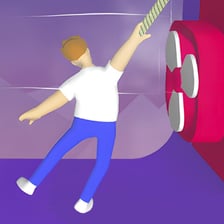
- Moving hazards, blades, blocks and swinging obstacles block the direct route.
- Reach the princess to complete the level.
The line is not a wall
The path guides the prince, it does not protect him. Anything that hits him while he is travelling will still knock him off, and a line drawn through a hazard is simply a line that ends there.
Ragdoll physics
The characters are not rigid. They swing, tumble and land badly, which means momentum carries over from one part of a path to the next.
That is worth knowing before you fight it. A steep drop into a curve will fling him further than the drawing suggests, and on several levels that is the intended solution rather than a mistake.
Tips and strategy
Watch a full cycle before drawing
Every hazard repeats. Spend one cycle doing nothing and you will see exactly where the gap is and how long it lasts.
That single habit is worth more than any drawing skill. Almost every failure on the first attempt at a level comes from starting before knowing the timing.
Draw short, draw often
A long path drawn in one go commits you to a plan made before the obstacles moved. A short path gets him past the immediate hazard and leaves the next decision until you can see it.
Think of the line as steering rather than as a route.
Use gravity instead of fighting it
Drawing upward is slow and unstable. Dropping him and catching him with a curve is fast and, once you are used to it, far more reliable.
Levels that look like they need a long climb usually have a swing or a fall that covers most of the distance for free.
Let go on purpose
Releasing the line is a move, not the end of a move. A prince released at the top of an arc keeps his momentum and sails through a gap that no drawn path could thread.
The hardest levels in the game are usually solved by a short push and a well timed release rather than by a complete path.
Speed is a variable you control
The steepness of your line sets how fast he travels. A gentle slope moves him slowly enough to time a gap, and a steep one gets him through a closing window.
When a level keeps failing at the same hazard, change the angle of approach before you change the route.
When a level looks impossible
Look for the thing that is not a hazard. A platform, a wall, a moving block you can ride on.
Levels that appear to have no route almost always have one element intended to be used rather than avoided, and the puzzle is noticing which one it is.
Learning the hazard types
The obstacles repeat across the forty levels, and each one behaves the same way every time you meet it. Learning what a given hazard does is worth more than getting better at drawing.
Swinging obstacles have a predictable arc with a long pause at each end, which is where the gap is. Blades that move in a straight line are the opposite, since their speed is constant and the only safe moment is behind them. Blocks that fall do so once, and then the space they occupied is permanently changed.
Treating each of these as a separate problem, rather than as generic danger, turns a level into a sequence of known quantities. A level with three hazards you understand is a timing exercise. The same level with three hazards you have not identified is guesswork.
When a new obstacle appears, spend a life on it deliberately. Watching what it does costs one attempt and saves five.
Similar physics puzzles here
Draw 2 Save Doge uses the same drawn line idea, Snail Bob 7 is the patient version where you alter the scenery instead, and Draw To Smash is the blunt one. More in puzzle and skill.
More games like this
Play our free daily puzzles See all →
Made by us. One a day, the same for everyone, no sign up.
Last updated
Frequently asked questions
How do you control the prince?
You draw a path with the mouse or your finger and he travels along it. Releasing the line stops guiding him, and his momentum carries on.
Does the drawn line protect him from hazards?
No. The line guides him but blocks nothing, so a path drawn through a blade simply ends there.
How many levels are there?
More than forty, and the later ones add more moving obstacles rather than new rules.
Why do my paths keep failing at the same spot?
Usually timing rather than route. Watch one full cycle of the hazard without drawing and the gap becomes obvious.
What is the ragdoll physics doing?
The characters are loose rather than rigid, so momentum carries between sections of a path. Falls and swings can be used deliberately to cover distance.
Is Save The Princess free?
Yes, free in the browser with no download and no account.