
Arkadium's Classic Solitaire
Free daily card games
A new deal every day, solved before it goes live, so it can always be won.


Arkadium's Classic Solitaire
 Our free daily · new every day Solitaire One winnable deal a day Play now
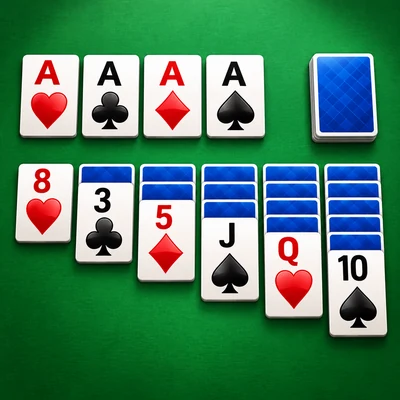
 Klondike is the game that came with every office computer for two decades and taught most of the world what solitaire is. Seven columns, twenty eight cards of which twenty one are face down, four empty foundations waiting for aces, and the rest of the deck in your hand.
It is also, quietly, a game most people play badly for years without noticing, because the losses look like bad luck. Some of them are. A meaningful share of Klondike deals cannot be won by anyone, no matter how well they play. But a larger share are lost by two or three specific habits, and they are easy to name.
This is Arkadium's version, with a clean board, unlimited undo and a running score.
How to play Arkadium's Classic Solitaire
Seven columns are dealt in front of you, the last card of each face up. Four empty foundations sit above.
- Build the foundations upward by suit, ace first, king last.
- Build the columns downward, alternating red and black. A red six goes on a black seven.
- Move a whole ordered run at once by dragging its highest card.
- Turn the stock when the board has nothing left to give.
- Only a king, or a run headed by a king, can move into an empty column.
The game is won when all fifty two cards are on the foundations. Undo is unlimited, so no single move is fatal.
What you are actually trying to do
It is tempting to think the goal is to fill the foundations, because that is how you win. In practice the goal for most of the game is to turn over face down cards.
Twenty one of them are hidden at the start. Every one you flip is information you did not have and a card that might unlock something. A move that sends a card to a foundation but reveals nothing has usually cost you more than it gained.
Tips and strategy
Judge every move by what it uncovers
Given two legal moves, take the one that turns a face down card. Given two of those, take the one from the longest column, because that is where the buried cards are stacked deepest.
If neither move reveals anything, deal from the stock instead. A board you have tidied without uncovering anything is a board that is about to stall.
Do not bank cards too early
Aces and twos should go up immediately. They can never be useful on the tableau.
Everything above that is a judgement call, and this is where good deals get thrown away. A five sent to the foundation is a five that cannot accept the four you turn over two moves later. Hold the middle cards on the board as long as they are doing work.
Empty columns are not free space
An empty column is the most valuable thing on a Klondike board and the easiest to waste.
Do not fill it with the first king you happen to be holding. Fill it with the king that unblocks the column you actually need to dig into. If no king does that, leave it empty and use it as somewhere to unload a run.
Emptying a column and immediately refilling it out of tidiness is one of the most common ways a winnable deal is lost.
Read the deal early
Look at where the trouble is before you start. Usually it is one column with a high card sitting on top of a long stack of hidden ones. Everything you do in the opening should be aimed at getting into that column.
If two columns are equally buried and neither has an obvious way in, you may simply have one of the deals that cannot be solved. Recognising it early saves the twenty minutes you would spend proving it.
The stock is a resource
How you work the stock decides more games than people realise.
Before you deal, exhaust the board. Every move available on the tableau should be made first, because dealing changes what is on top of the waste pile and you cannot get the previous card back until the pile comes round again.
And when you do deal, pay attention to what passes. Noting that the card you need is three cards deep in the stock tells you how many deals away it is, and that is often the difference between planning a route and hoping for one.
Use undo as a tool
Because the board is fully visible after a while, working backwards from a jam tells you which move was the mistake. That lesson carries into the next deal in a way a fresh shuffle never does.
Where to go next
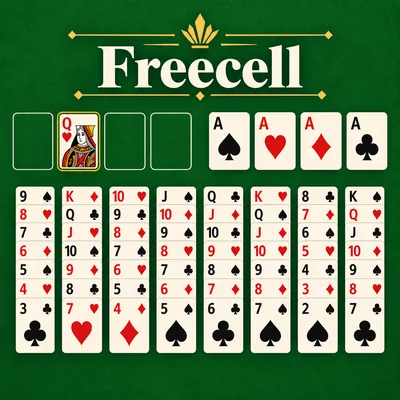
Klondike Solitaire is the same game with a different deal, FreeCell shows every card from the start and is almost always winnable, and Crescent Solitaire and Addiction Solitaire change the rules enough to feel new. The collection is in cards and cards.
More games like this

Play our free daily puzzles
See all →Made by us. One a day, the same for everyone, no sign up.
Last updated
Frequently asked questions
Can every game of Klondike be won?
No. A meaningful share of deals cannot be solved no matter how well you play, which is why restarting is not a failure.
What can go into an empty column?
Only a king, or a run of cards headed by a king. That restriction is why clearing a column too early can cost you the game.
Should I always send cards to the foundation?
Aces and twos, yes. Higher cards are often worth holding on the board, because they may be needed to accept cards you have not turned over yet.
What is the most useful habit to build?
Judging every move by whether it turns over a face down card. A tidy board that revealed nothing is a board about to stall.
How many times can I go through the stock?
As many as you need in this version, so a card you passed will come round again.
Is it free to play?
Yes, free in the browser with no download, no account and no payment.