Cryptogram: Word Brain Puzzle


Cryptogram: Word Brain Puzzle
 Our free daily · new every day Findish A word search with a new theme every day Play now
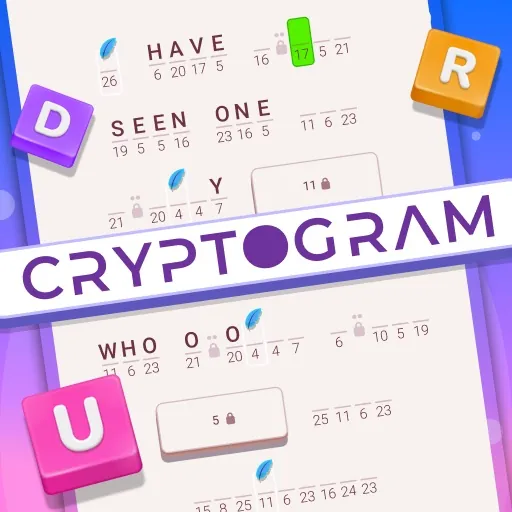
 A cryptogram is a quotation with every letter replaced by a different one, consistently, and no key.
What makes it a good puzzle rather than a chore is that you are not guessing. You are reasoning. A one letter word is A or I. A three letter word appearing twice is almost certainly THE. An apostrophe followed by a single letter is S or T. Each of those observations locks letters across the entire text at once, and the solution unravels in an accelerating rush rather than steadily.
The quotes are the other half of it. You are decoding something someone actually said, so finishing a puzzle ends with a sentence worth reading rather than with a score.
- An encrypted quote appears, with each letter standing consistently for another.
- Choose a letter and assign what you think it represents.
- Every occurrence of that letter updates across the whole text at once.
- Undo an assignment if it produces something impossible.
- Decode the full quote to finish the puzzle.
How to play Cryptogram: Word Brain Puzzle
Where to start
Short words carry the most information per character.
A single letter word is A or I. Two letter words are a small set: OF, TO, IN, IT, IS, BE, AS, AT, SO, WE, HE, BY, OR, ON, DO, IF, ME, MY, UP, AN, GO, NO, US, AM. A three letter word that appears more than once in a short quote is usually THE or AND.
Frequency
In English, E is the most common letter by a wide margin, followed by T, A, O, I and N. Count which cipher letter appears most and start by testing it as E.
Working backwards from errors
If an assignment forces an impossible letter combination somewhere else in the text, it is wrong. Undo it immediately. The instinct to keep going and hope it resolves is what turns a ten minute puzzle into a forty minute one.
For the grid version of the same cipher idea, try Arkadium's Codeword, and the clued puzzles are on the crossword page.
Tips and strategy
Opening moves
- Count letter frequencies before assigning anything. The most common symbol is E far more often than not.
- Solve the one and two letter words first. They are the most constrained parts of the text.
- Look for an apostrophe. The letter after it is almost always S, T, D, M, LL or RE, which is a very small field.
Building out
- Once you have E and T, look for THE. Finding it gives you H for free and confirms both.
- Doubled letters narrow sharply. English commonly doubles L, S, E, O, T, F and N and rarely doubles anything else.
- Word endings are gifts. ING, ED, LY and TION are visible as shapes once you have three or four letters placed.
The usual errors
- Guessing a whole word from its shape without checking that its letters work everywhere else they appear.
- Continuing after a contradiction instead of backing out immediately.
- Ignoring punctuation. Apostrophes and short words are the most informative marks in the text.
More games like this
Play our free daily puzzles See all →
Made by us. One a day, the same for everyone, no sign up.
Orientation
Built for a landscape screen. On a phone, turn the device sideways.
Last updated
Frequently asked questions
What is a cryptogram?
A quotation with every letter consistently replaced by a different one. You solve it by deducing which cipher letter stands for which real letter.
How do I start a cryptogram?
Count which symbols appear most often, since E dominates English, and solve the one and two letter words first because they are the most constrained.
Are the quotes real?
Yes. The puzzles are built from real sayings and lines, so finishing one leaves you with something worth reading.
What if I make a wrong assignment?
Undo it as soon as it produces an impossible combination elsewhere. Carrying on and hoping is what turns a short puzzle into a long one.