

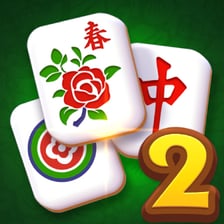







Mahjong Story 2
Most mahjong solitaire games give you a layout and leave you to it. Mahjong Story 2 gives you a thousand of them, arranged into worlds you travel through, with the difficulty rising as you go.
Whether that is an improvement depends on what you want from the game. A single classic layout is a puzzle you either solve or restart. A run of a thousand is a habit, and the design is honest about which it is aiming for.
The rules underneath have not changed since mahjong solitaire was invented. Free tiles, matching pairs, and a layout that punishes taking the easy ones first.
How to play Mahjong Story 2
Tiles are stacked in layers, and only some of them can be taken.
- Click two identical tiles to remove the pair.
- A tile is free when nothing rests on top of it and one of its left or right sides is open.
- A tile hemmed in on both sides is locked, even in plain view.
- Flowers match any flower, seasons match any season.
- Clear the layout to move to the next level.
What a thousand levels actually means
The layouts vary in shape rather than in rules, and shape is what sets the difficulty in this game.
Wide and flat is forgiving, because most tiles start with an open side. Tall and dense is punishing, because almost everything is locked under something else and there is usually one thread that unravels it.
Look at the silhouette before your first click and you will know which kind of level you are on.
Progression and difficulty
Early worlds are gentle enough to play without thinking. Somewhere in the middle they start requiring you to plan the order, and the change is gradual enough that most players do not notice until they hit a level that stops them.
Tips and strategy
Only clear what uncovers something
The tiles around the outside of a layout are free at the start and stay free. Removing them early spends a move and gains nothing.
The tiles under the top layer are the only ones that need help. Every pair you take should ideally free something else, and when two pairs are both legal, take the one that opens more.
The four copy trap
Every tile face exists four times. When all four are free, taking two is safe. When two are free and two are buried, those free ones are the only things that can ever match the buried ones.
Spend them thoughtlessly and the level is already lost, several minutes before it becomes obvious. The habit that avoids it: match a buried copy against a free one, and keep the second free tile in reserve.
Read the layers, not the faces
Beginners scan the whole board for matching pictures. That is a large search and most of the results are unplayable.
Faster players scan for free positions first and then read what is in them. There are far fewer free tiles than tiles, so the search is smaller and every candidate it produces is actually legal.
Long single width rows
Many layouts include a row one tile wide. Each tile in it is reachable from one end only, so the order is forced.
Start at whichever end has a tile whose partner you can already see, and work inward. Opening both ends at once feels efficient and strands whatever is in the middle.
Hints and shuffles
Both are limited and both are better spent late than early. A hint used at the first hesitation shows you the pair you were about to find. A shuffle used before the board is genuinely locked throws away the order you were building.
Knowing a dead board
Layouts can reach positions with no legal move, and no amount of looking changes that. The signal is a handful of tiles left, each alone in its own stack, with the remaining faces split between positions that block one another.
Recognising that quickly is a skill. Restarting is the correct response, not a failure.
Playing a long run without burning out
A thousand levels is a lot, and the way most people stop is not difficulty. It is that the levels blur.
Two things help. First, treat each layout as a fresh reading problem rather than continuing on autopilot, which means looking at the silhouette before the first click even on level four hundred. Second, stop while you are still enjoying it. A game built as a habit will happily take an evening, and the levels will still be there.
What the theme changes
The worlds change the artwork and, more importantly, the tile faces. Some sets are considerably easier to read at a glance than others.
If a world feels harder than the one before it and the layouts look similar, the difference may simply be that you are misreading tiles rather than misplaying them. Slowing down for one level usually tells you which it is.
Other mahjong here
Classic Mahjong is the traditional turtle without the progression, Mahjong Kitchen and Mahjong Firefly are the themed ones, and Mahjong 3D puts the tiles on a block you rotate. More in mahjong.
More games like this


Play our free daily puzzles See all →
Made by us. One a day, the same for everyone, no sign up.
Last updated
Frequently asked questions
How many levels does Mahjong Story 2 have?
More than a thousand, arranged into themed worlds with the difficulty rising as you progress.
What makes a tile free?
Nothing resting on top of it, and at least one of its left or right sides open. A tile you can see clearly may still be locked.
Which pairs should I take first?
The ones that uncover tiles underneath. Edge tiles stay available all game, so clearing them early wastes your easy moves.
Why do some levels feel much harder than others?
The layout shape rather than the tiles. A tall dense stack locks nearly everything, while a wide flat one gives you options from the first move.
Can a level become impossible?
Yes. When the remaining tiles block one another there is no legal pair left, which is what shuffles are for and why restarting is normal.
Is it free to play?
Yes, free in the browser with no download and no account.