
Words with Owl

Words with Owl
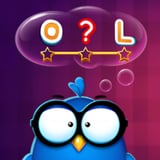
Words with Owl shows you a word with pieces missing and asks you to put them back, quickly.
It is a narrower exercise than most word games here and that is its advantage. You are not searching a board or building from a rack. You are recognising a word from a fragment, which is a different skill and a faster one to train. The clock rewards recognition rather than deduction, so the players who do well are not the ones with the biggest vocabulary but the ones who read fastest.
Points scale with speed, and levels unlock as you go.
How to play Words with Owl
- A word appears with one or more letters missing.
- Choose the correct letters from the options shown.
- Faster answers score more.
- Keep solving to unlock further levels.
- The clock runs throughout, so hesitation costs points.
Recognition over reasoning
The words are ordinary. If you are working out what the answer could be, you have already lost the points, because the answer is meant to arrive before the analysis does.
The way to get faster is counterintuitive: look at the whole word shape rather than at the gap. Readers recognise words by outline, not letter by letter, and staring at the missing position blocks the recognition that would have handed you the answer.
Managing the clock
Because scoring falls off with time, a wrong fast answer often costs less than a right slow one. If two options both look plausible, taking one immediately is usually better than deliberating.
Tips and strategy
Getting faster
- Read the whole word, not the gap. Word recognition works on shape and the gap interrupts it.
- Check the letter options first, before looking at the word. Often only one of them produces anything real, which turns the puzzle into a single glance.
- Sound it out silently. Pronunciation resolves most missing vowels instantly.
Where the traps are
- Missing vowels are harder than missing consonants, because more of them fit.
- Words with a doubled letter catch people out, since the eye supplies a different letter rather than a repeat.
- Long words are usually easier than short ones. More letters means more context and fewer valid alternatives.
Common mistakes
- Deliberating between two plausible options while the score decays.
- Staring at the gap instead of the word.
- Playing long sessions. This is a recognition drill and recognition degrades quickly with fatigue.
For deduction rather than recognition, Guess Word is here, and the rest are on the word games page.
More games like this
Play our free daily puzzles See all →
Made by us. One a day, the same for everyone, no sign up.
Orientation
Built for a landscape screen. On a phone, turn the device sideways.
Last updated
Frequently asked questions
How does scoring work in Words with Owl?
Points scale with speed. A fast answer is worth more than the same answer given slowly, which is why hesitation is expensive.
Are the words difficult?
No. The vocabulary is ordinary. What is tested is how quickly you recognise a word from a fragment.
What is the fastest way to improve?
Read the whole word rather than staring at the gap. Recognition works on word shape, and focusing on the missing position blocks it.
Is it timed?
Yes. The clock runs throughout and scoring falls off as it does.
Is Words with Owl free?
Yes. It runs in the browser with nothing to install and no account.